Showing posts with label St. John's Passion. Show all posts

Saturday, April 7, 2018

Bach's Johannespassion (Part 3: the mystery of the choir)


In the past two articles I wrote on Bach's Johannespassion, I referred to the dual role of the choir (Part 1 and Part 2).
"The pain that accompanies the joy, borne of Christ's suffering, becomes our own pain, the people's pain, the choir's pain, as the choir plays the part of Christ's followers and indeed all humankind." 
"The choir itself has two roles -- to sing to God as Christians, and to reenact the passion as a mob, as Jews." 
"I find the structure of the work fascinating in the way it moves back and forth between different characters, arias, recitative and the chimerical choir."
The choir of this oratorio sings three kinds of music:

Friday, March 30, 2018

Bach's Johannespassion (Part 2: the mystery of Bach)

I had the pleasure of hearing Bach's Johannespassion on Palm Sunday in the Grossmünster of Zurich. It was sung by the Bach Collegium, in which my friend Laura sings. On Easter Sunday this year I will be in Amsterdam, and the Concertgebouw is giving the Matthäuspassion, so I will hear these two works a week apart, each for the first time. Obviously, two sung passion plays by Bach are going to have as many similarities as differences (Bach told the story of Christ's crucifixion at least three times in large-scale works), and before I sink into this later, more intimate and pensive work (Matthäuspassion), I'd like to spend more time thinking about the more intensely dramatic Johannespassion that affected me so.

For reference I really admire this recording from Munich, conducted by Karl Richter, sung by an enormous chorus of ice-cold Germans:


I find it impossible to imagine what sort of a man Bach was, harder still to imagine the emotional world he inhabited (and the far less religious one that usurped it). The music itself would point to a man of the deepest, most mystical religious devotion. The non-Biblical libretti circle over and over again around the humility needed to honor God, around the gracious gift of undeserved mercy. The thought that, until Mendelssohn, this massif of artistic ambition went mostly unperformed beyond Leipzig for a hundred years, der Schall nearly verschollen -- it boggles the mind that the question of posterity did not appear to concern him, or that any steps he took for his own posterity were only meagerly successful, and left no traces in his music. Is this Bach an artist without ego? Would our modern idea of an artist concede even the possibility of such a thing? Writing music for any given Sunday, music that lasts for a thousand years? Is this Bach merely a talented family man working to please a court patron, his talent a coincident miracle? 

Wednesday, March 28, 2018

Bach's Johannespassion (Part 1: the mystery of the music)

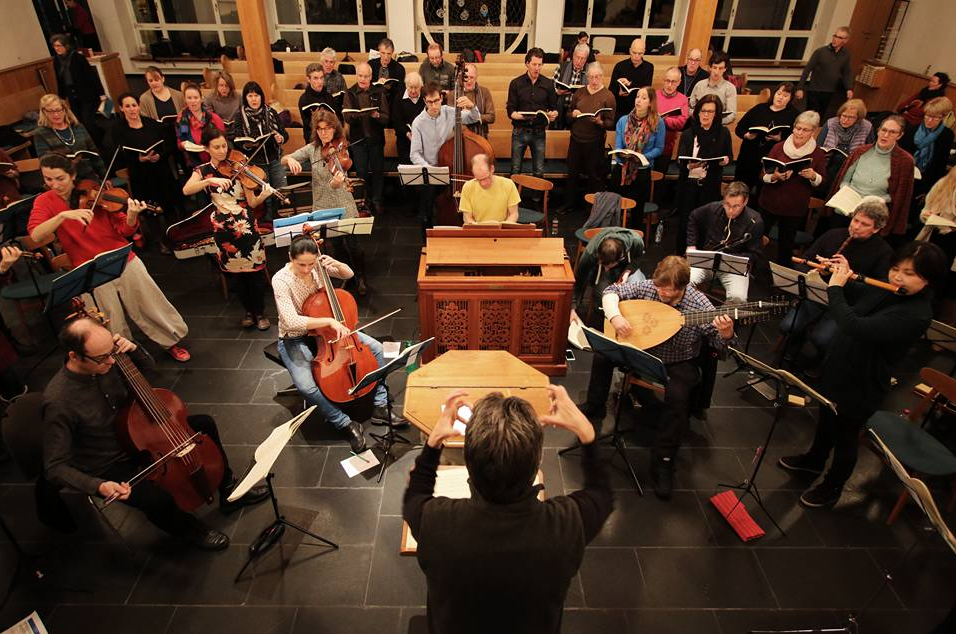
I had the intense pleasure of hearing Bach's Johannespassion on Palm Sunday in the Grossmünster of Zurich. It was sung by the Bach Collegium, of which my friend Laura is a member, and it was the first time I had heard the work live. I have been listening to it for about a year. I am besotted by it and am writing a few notes in the hope that you might also find it meaningful.


Photo Credit: Bach Collegium Zürich


Beginnings: the opening chorale

"Herr, unser Herrscher": the strings come climbing at you from a low octave, woodwinds darkening the atmosphere with a plaintive cry. The pulse is gentle and insistent. The first climax ('43) is full of mercy, climbing back down as gracefully as the ascent was anguished. Then comes the crescendo of first text: Lord, our master. It is proclaimed exclaimed, private and piercing. It feels fortissimo and sounds mezzo-forte. The strings and winds continue their ostinato thrust. 11 full minutes it takes for the ternary opening to announce that God is great, to evoke Christ's humiliation and lowliness, to announce anew that God is great.

The psychology of such music is hard to pin down; it is stupendously beautiful, affecting. It is grandly convinced of God's greatness, as bold a sound as anything intended to witness something magisterial. And the pain that accompanies it, borne of Christ's suffering, becomes our own pain, the people's pain, the choir's pain, as the choir plays the part of Christ's followers and indeed all humankind. 

How can these two conflicting sentiments be mixed? Why is it that Bach's Pietism is so articulate, so lavish in showing the exquisite nature of joy amidst suffering? Why is joy itself true most when it is seated at the table of morbidity? I think of New Orleans and its jazz funerals, the dirges preceding the hymns, death before life, Mahler's "Sterben will ich, um zu leben". They make so much of our modern pleasure-joy appear hollow, unaccompanied as it mostly is by any rootedness in the yang of sadness.