Showing posts with label sincerity. Show all posts

Saturday, April 7, 2018

Bach's Johannespassion (Part 3: the mystery of the choir)


In the past two articles I wrote on Bach's Johannespassion, I referred to the dual role of the choir (Part 1 and Part 2).
"The pain that accompanies the joy, borne of Christ's suffering, becomes our own pain, the people's pain, the choir's pain, as the choir plays the part of Christ's followers and indeed all humankind." 
"The choir itself has two roles -- to sing to God as Christians, and to reenact the passion as a mob, as Jews." 
"I find the structure of the work fascinating in the way it moves back and forth between different characters, arias, recitative and the chimerical choir."
The choir of this oratorio sings three kinds of music:

Wednesday, March 28, 2018

Bach's Johannespassion (Part 1: the mystery of the music)

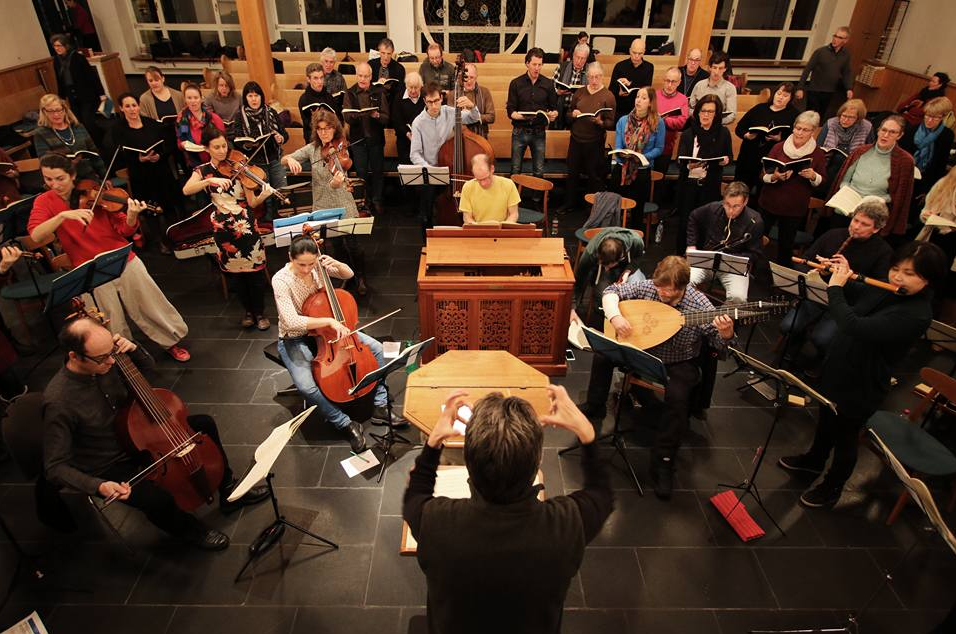
I had the intense pleasure of hearing Bach's Johannespassion on Palm Sunday in the Grossmünster of Zurich. It was sung by the Bach Collegium, of which my friend Laura is a member, and it was the first time I had heard the work live. I have been listening to it for about a year. I am besotted by it and am writing a few notes in the hope that you might also find it meaningful.


Photo Credit: Bach Collegium Zürich


Beginnings: the opening chorale

"Herr, unser Herrscher": the strings come climbing at you from a low octave, woodwinds darkening the atmosphere with a plaintive cry. The pulse is gentle and insistent. The first climax ('43) is full of mercy, climbing back down as gracefully as the ascent was anguished. Then comes the crescendo of first text: Lord, our master. It is proclaimed exclaimed, private and piercing. It feels fortissimo and sounds mezzo-forte. The strings and winds continue their ostinato thrust. 11 full minutes it takes for the ternary opening to announce that God is great, to evoke Christ's humiliation and lowliness, to announce anew that God is great.

The psychology of such music is hard to pin down; it is stupendously beautiful, affecting. It is grandly convinced of God's greatness, as bold a sound as anything intended to witness something magisterial. And the pain that accompanies it, borne of Christ's suffering, becomes our own pain, the people's pain, the choir's pain, as the choir plays the part of Christ's followers and indeed all humankind. 

How can these two conflicting sentiments be mixed? Why is it that Bach's Pietism is so articulate, so lavish in showing the exquisite nature of joy amidst suffering? Why is joy itself true most when it is seated at the table of morbidity? I think of New Orleans and its jazz funerals, the dirges preceding the hymns, death before life, Mahler's "Sterben will ich, um zu leben". They make so much of our modern pleasure-joy appear hollow, unaccompanied as it mostly is by any rootedness in the yang of sadness. 

Wednesday, April 8, 2015

Tristan och Isolde, Tristan und Isolde, Tristan and Isolde: American viewing German opera in Swedish (Part 3)

Eins vorweg: I was very impressed with a quotation about reviewing and criticising literature that a friend of mine shared, and I wanted to share it further. That friend is Timmy Haase, who teaches Latin and Greek literature in the U.S. It's from Practical Criticism (1929!), by the apparently important I. A. Richards:

"Details of scansion [meter], opportunities for grammatical objection, for allegations of descriptive inaccuracy, for charges of logical inconsistency, share this attraction [i.e. of "objective" or measurable criteria for evaluating texts]. To put the point generally, all those features which can be judged without going *into* the poem, all details or aspects that can be scrutinised by the mind in its practical, every-hour, non-poetical capacity, are so many invitations to make short work of the task of critical appraisement. Instead of trying the poem on, we content ourselves with a glance at its lapels or buttons. For the details are more easily perceived than the *ensemble*, and technical points seem more obtrusive than the point of the whole."  

And later, 

"The sovereign formula in all reading is that we must pass to judgment of details from judgment of the whole. It is always rash and usually disastrous to reverse the process."

With those rousing words I will attempt to write just a little about the Royal Swedish Opera's production of Tristan och Isolde (here in Swedish), and my own experience viewing it.

Wednesday, October 28, 2009

Blog Hard

The first post: account for the name, manifesto-style:

1. The 'e' is self-evident. Plus, an American friend went to Spain this summer, and returned with a stray 'e' at the beginning of assorted words (e.g. eSpain, eSpanish, eTC.). The eFfect was eHumorous.

2. "Age of Precarious" was already taken.

3. As a committed statist whose skin crawls at the mention of tax cuts and the loss of personal liberty, I want the government in my life. I want to walk amongst fellow citizens and know that their stake is my stake and that the terrain we share is a combination of the respected private and the well-fostered public. The proper balance of private and public is to my mind the main challenge of sustaining an industrial nation-state (in the long-term; the unbalance in the U.S. is what makes us big, and topsy-turvy). I attempt, and fail, to always factor in the pursuit of that balance in what I do, say, and think.

My hopes for this blog are to talk about all sorts of different topics, without falling victim to self-obsession. I've spent a long time resenting blogs and bloggers, somewhat cattily so. Now I'm a copycat.